
70th Anniversary
Jubilee Album – 70th Anniversary of the School of Foreign Languages
Electronic edition of the jubilee album.
Selected dates from the history of the Centre
60th Anniversary
History of the School of Foreign Languages on its 60th anniversary
“Sixty years may not seem like a lot against the backdrop of the University’s history, but it is nevertheless an entire era. The School of Foreign Languages, celebrating its 60th anniversary this year, changed along with the era, starting with its very name; first it was the Center for Practical Foreign Language Teaching, then the ‘minimalist’ School of Foreign Languages, in the 1980s the acronym MONJO appeared – Inter-Faculty Centre for Foreign Language Teaching – and finally, in 1991, the current name was adopted – simple, unpretentious, with equivalents in the names of many distinguished higher education institutions in various countries.
The location also changed: the first floor of the Polish Studies building, squeezed in above the post office in the Auditorium Maximum, Oboźna Street, 69 Nowy Świat Street. And currently – in addition to the second floor on Nowy Świat – its own building on the main campus, inherited from the English Studies department.
Textbooks and teaching styles changed: from crude, falling apart, ‘socialist’ scripts, through solid, concise Eckersleys or Candlins, attractive volumes from the Vers la France series, ideologized but solid Soviet or East German textbooks; there were also Smólska, Szkutnik, Hilda Andrews-Rusiecka, or Alexanders populated with funny creatures; grammar-translation method, structural method or the hit of the sixties and seventies: language laboratories. Now the internet sets the tone with all its inventory and teleinformatic-electronic equipment.
The teaching style has also changed, focused on effective communication, with a simultaneous emphasis on academic language or specialized languages. A lecturer, a language teacher is nowadays more of a guide and a ‘facilitator’ than the walking textbook of yesteryear. Students travel, go on EU scholarships, the number of foreign listeners is growing (including those from Japan, China, India, Kazakhstan, Turkmenistan, Saudi Arabia, South America and most European countries), the perception of languages is changing, and more and more of them are included in the school’s offer. Over a hundred teachers employed here support students in learning and improving English, French, German, Spanish, Italian, Russian and recently – Swedish and Dutch. The School is the largest unit conducting language courses at UW as part of the University Foreign Language Teaching System. Every year over 7,000 students take language courses.”
More: p. 7 of the university magazine University of Warsaw, No. 5 (65), October 2013
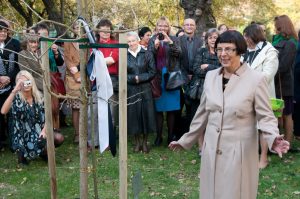
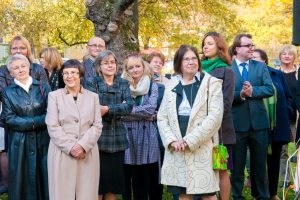
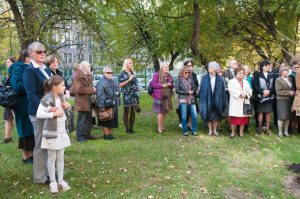
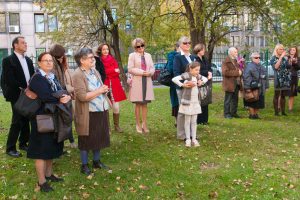

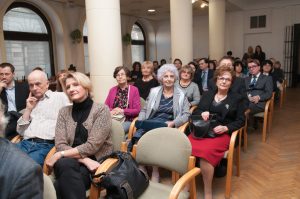
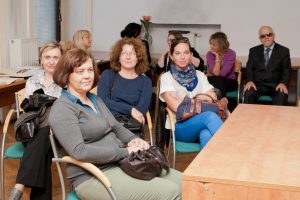
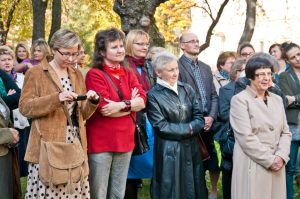

50th Anniversary
The beginnings of the Center for Practical Foreign Language Teaching
“The first stage was the activity of the Center for Practical Foreign Language Teaching. Based on an order from the Ministry of Higher Education, the then-rector established the Center for Practical Foreign Language Teaching, which included full-time teachers: 13 for Russian, 4 for German, 3 for French, and 5 for English.
The first head of the center was Mr. Piotr Sobolewski, MA, a man with a highly fascinating biography and versatile interests. Born in Vilnius to an intelligentsia family, he studied theology at UW before World War II, then went on to doctoral studies at the University of Athens. During the occupation, he was involved in underground teaching, and after the war, he became the secretary of the Special Commission for the Investigation of German Crimes and co-created the museum in Majdanek. He then worked as an official in the Ministry of Foreign Affairs, which he left to start teaching at UW. In 1959, he graduated in Russian philology while already serving as the head of the School of Foreign Languages.
The Center was divided into teams grouping teachers of Russian, French, German, and English, and also taught Latin.
In the 1960s, it was called the School of Foreign Languages (UW) and already taught 6,000 students. They learned Russian (which was mandatory) and one Western language (out of three to choose from), as well as Latin, if required by the study program; classes were held in the 1st and 2nd years for 2 hours a week.
The Center organized optional groups for specific faculties. It is an interesting fact that classes for students going abroad were held, as it was described then, by the tape recorder or record player, among other places in the phonetic center of the Institute of French Culture. Furthermore, it was established that language classes were to be held in the morning, at least once a week for 2 hours.”
More: p. 18–20 of the university magazine University of Warsaw, No. 2 (18), April 2004
Directors of CNJO
Heads and coordinators of language teams
English Language Team
- since 2021: Anna Łętowska-Mickiewicz, MA
- 2010–2021: Elżbieta Habielska; deputies: Dr. Sylwia Kossakowska-Pisarek (2013–2017), Agnieszka Harrison (2018)
- 2007–2010: Bartosz Jurczak; deputy: Agnieszka Harrison
- 2006–2007: Bożena Górska-Poręcka
- 2003–2006: Maria Wożniak
- 1997–2003: Mirosława Wojciechowska-Szepczyńska
- before 1997: Mirosława Wojciechowska-Szepczyńska; Jolanta Urbanik (1987–1991); Krystyna Paszkowska-Hoppe; Jan Bartkowski; Marta Franciszkiewicz (Pasierbińska) (1994–1995); Agnieszka Wiloch-Sikorska (1992–1994), deputy: Ewa Górczyńska; Anna Chachulska-Julien
Germanic Languages Team
- since 2006: Dr. Elżbieta Lewkowicz
- 2005–2006: Elżbieta Fijałkowska – substituted for Ms. Kamińska in 2005; then one year as head
- 1991–2005: Krystyna Kamińska
- 1990–1991: Barbara Domińska
- before 1990: Irena Grzesiowska
Romance Languages Team
- since 2021: Arkadiusz Misiak, MA
- 2007–2021: Jolanta Morytz
- 2003–2007: Irena Dąbrowska
- 1989–2003: Róża Somla-Dębowska
- before 1989: Kalina Szymanowska, Leszek Chachulski
Russian Language Team
- since 2018: Magdalena Ziółek-Wojnar, MA
- 2017: Krzysztof Świrko
- 2007–2017: Wojciech Sosnowski; with a break for leave in 2015–2016 – acting head Magda Tulska-Budziak
- 1990–2005: Jadwiga Koperska
- date undetermined: Lidia Wróbel
- 1985–1986: Janina Furgałowa – acting head of the Team replacing Zofia Bałakier (leave)
- 1970s/80s: Alicja Spirydowicz
- date undetermined: Stanisław Nikoniuk